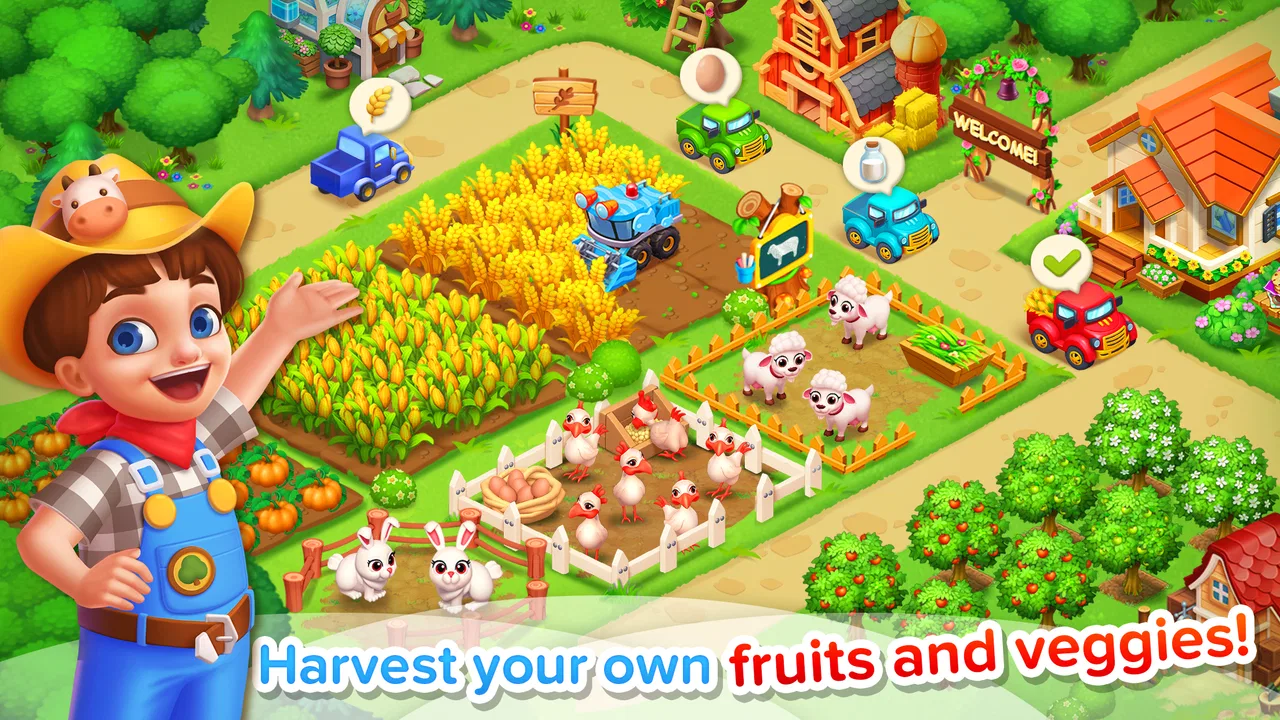
Family Farm Seaside®
- 4.2
- Rating
- 50.00M
- Installs
- Free
- Price

 Analysis by App-foxy
I spent time with Family Farm Seaside® as a relaxed farming game, and its appeal became clear quickly: it gives you a cheerful place to grow crops, look after animals, make products, and keep expanding at your own pace. It is made by Century Games PTE. LTD., belongs to the casual game category, and is free to start. That combination makes it easy to try, although the long-term value depends on how comfortably you play around its optional purchases.
The game is aimed at a broad audience, with an Everyone age rating, and it has been available since February 25, 2013. That long history is noticeable in the amount of content packed into the farm experience. It feels less like a tiny time-filler and more like a continuing hobby game, especially once you begin juggling several production steps at once.
How the farm works in everyday play
The basic rhythm is familiar but effective. I plant or collect materials, wait for production to finish, use the results in other activities, and then decide what deserves space on the farm. The satisfaction comes from turning a simple harvest into a chain of useful goods rather than merely tapping a single button and moving on.
You May Also Like

 AccuWeather: Weather Radar
AccuWeather Review: A Quick, Clear Forecast for Everyday Decisions
For everyday plans, the best forecast is the one you can understand quickly. AccuWeather makes rain timing, radar, and local conditions easy to act on, with a few trade-offs.

 Hill Climb Racing
Why Hill Climb Racing Still Turns Crashes Into One More Run
A tiny car, a bumpy hill and one more upgrade: Hill Climb Racing keeps resurfacing because its simple chaos makes every near-miss feel personal.

 AliExpress - Shopping App
AliExpress Makes Global Shopping Feel Personal, but Shoppers Bear the Risk
AliExpress turns a global marketplace into a pocket-sized discovery engine. Its reach is useful, its shopping loop compelling, and its trade-offs easy to miss.

 Lords Mobile: Kingdom Wars
Lords Mobile Is a Kingdom-Building Routine, Not a Quick Match
A case-by-case verdict on the building, battles, device demands, and social commitments that make Lords Mobile rewarding for some players and exhausting for others.

 PDF Scanner app - TapScanner
TapScanner Makes Paperwork Easier to Capture, Check, and Share
TapScanner makes scanning with a phone feel less like a rescue operation and more like a dependable step in getting work done. Its capture tools are useful, though not flawless.

 Block Blast!
 Shows How Much a Puzzle Game Can Leave Out
A quiet grid game shows why puzzle players increasingly value instant clarity, repeatable skill and low-pressure play—and where the genre still needs to catch up.
More From Our News Desk
View All News


That chain gives the game more texture than a basic crop-growing title. A short session can involve checking what is ready, starting the next batch, clearing room for another activity, and choosing whether to focus on immediate tasks or longer goals. I found this especially comfortable when I had only a few minutes, because there was usually something small to complete without demanding a full play session.
The store summary highlights playing together with family, and that is a fair description of the tone. The presentation is friendly and non-threatening, with the kind of bright farm setting that works well for younger players and adults who want something gentle. The large selection of products also gives the farm a sense of progression: there is always another item or production objective to work toward.
One useful detail is the promise of unlimited barn space. Storage limits can be one of the most irritating parts of farming games, so removing that particular pressure changes how I plan. I can keep materials for later instead of constantly throwing away items simply to make room. That does not remove every management decision, but it makes the experience less punishing than games that turn storage into the main obstacle.
A good fit for short sessions and shared routines
My favorite way to use it was in small visits throughout the day. In the morning, I could start tasks that needed more time. Later, I would return to collect the results and prepare another round. This works well for someone who enjoys gradual progress while watching television, taking a break, or winding down before bed.
It can also become a pleasant shared routine in a household. One person may enjoy planting and collecting, while another prefers organizing the farm or checking which products should be made next. The game does not need to be treated as a competitive challenge to be enjoyable. Its strongest social quality is that the subject matter is easy to understand and inviting enough for family members with different gaming habits.
That said, “play together” should not be read as a reason to choose it if you specifically want deep real-time multiplayer action. The attraction here is the shared theme and accessible routine, not the intensity of a competitive online game. Someone looking for fast matches, complex strategy, or a strong narrative campaign will probably find this farm too calm.
What makes the progression satisfying
The product system is the heart of the experience. Instead of treating every task as an isolated reward, the game encourages me to think about what I will need next. If I spend all my materials on one tempting item, I may have less flexibility for another objective. That creates small but meaningful decisions without turning the game into a spreadsheet.
I recommend keeping a mental priority list rather than trying to complete everything immediately. When several requests appear, I first look for tasks that use materials already available or that unlock a useful next step. This reduces wasted waiting time and makes the farm feel more organized. It is a simple habit, but it matters once the number of activities grows.
Another practical approach is to use the generous storage situation strategically. Rather than processing every item the moment it appears, I can hold a useful reserve and wait until a task or production chain makes better use of it. This is one of the less obvious strengths of the game: the absence of a tight barn ceiling lets me plan around future needs instead of reacting to storage warnings.
Cost, free access, and the role of purchases
There is no upfront price to begin playing. I could install the game and explore its farming loop without paying first, which makes it easy to recommend as a trial for anyone curious about this style of casual game. The free entry is meaningful because the central question is not whether the game can be opened without spending, but whether its pace remains enjoyable when I choose not to buy anything.
Optional in-app purchases range from $0.99 to $99.99 per item. That is a wide span, so I would treat the purchase screen carefully rather than assuming every offer has the same value. The important distinction is that free access lets you judge the basic experience yourself, while paid items are a convenience or acceleration choice rather than a requirement for discovering whether the farming loop suits you.
I would not buy anything during the first session. I would first learn how quickly normal progress feels, identify which waiting periods actually bother me, and decide whether the game is something I expect to return to regularly. If the routine is already relaxing, spending may feel unnecessary. If I enjoy the game but want to support longer sessions, a small purchase is easier to evaluate than jumping straight to a large one.
The game’s value is therefore personal. A free player receives a substantial casual farming pastime with room to build a routine. A paying player may value saved time or extra convenience, but the purchase price alone does not guarantee a better experience. For me, the strongest value comes from the content and the flexible storage approach, not from treating spending as the main way to progress.
Where the experience can become frustrating
The same waiting-based structure that makes the game easy to fit into daily life can also slow it down. If I want immediate, uninterrupted progress, farming timers and production steps can feel like barriers. The game rewards returning later, so it is less satisfying for anyone who prefers to finish a complete challenge in one sitting.
There is also a risk of turning the farm into a checklist. Once I start chasing every available objective, the relaxed mood can give way to constant optimization. I get better results when I choose a few priorities and ignore the rest temporarily. This is not a flaw unique to this title, but the large amount of activity makes self-imposed pressure easy to create.
The broad product selection is another tradeoff. It gives the game longevity, but it can make the farm feel busy when I am still learning what each item is for. New players should avoid trying to memorize the entire system. I found it more comfortable to follow the immediate goals, notice which materials recur, and gradually build a personal routine.
The free-to-play structure also deserves honest attention. Even when a game is enjoyable without spending, purchase prompts can change how the experience feels. Players who dislike any suggestion of paid acceleration may become annoyed, while players who are comfortable waiting will probably find it easier to ignore those offers. I would skip this game if the mere presence of optional purchases makes a casual title feel stressful.
How it compares with other casual farming games
Compared with a very simple farm game, this one offers more to manage because the focus is not limited to planting and harvesting. The product-making layer gives me more reasons to return and more choices about what to prepare next. That makes it a better match for players who want a continuing routine rather than a minimal tap-and-collect toy.
Compared with a heavily competitive casual game, it is much more forgiving in tone. There is no need for quick reflexes, advanced tactical knowledge, or a perfect performance every time I open it. The tradeoff is that the excitement is quieter. If you want dramatic victories, direct competition, or rapid rounds, another category of game will serve you better.
It also differs from story-first farming adventures. Here, the appeal is the ongoing farm and its production rhythm rather than a single narrative that I can finish. That makes it suitable for players who like open-ended progress, but less suitable for anyone who wants a clearly defined ending or a tightly scripted journey.
Who will get the most from it
I think it is a strong choice for casual players who enjoy collecting, organizing, and gradually unlocking more things to do. It is particularly approachable for families because the setting is friendly and the rules are easy to explain. The Everyone rating supports that broad accessibility, although adults should still guide younger players around optional purchases.
It also suits people who prefer games that respect irregular schedules. If you can check in briefly, start a few tasks, and return later, the structure feels natural. The unlimited barn space is especially helpful for players who dislike throwing away resources or making constant storage decisions.
Players who enjoy planning will find more depth than the colorful presentation initially suggests. My practical advice is to reserve materials for recurring production needs, avoid spending simply because a timer is inconvenient, and use short visits to keep several activities moving. Those habits preserve the relaxed side of the game while reducing unnecessary delays.
On the other hand, I would skip it if you need a game that is fully satisfying offline in a single uninterrupted sitting, or if waiting-based progression immediately feels like a chore. I would also look elsewhere if your priority is a serious multiplayer competition, a demanding strategy system, or a story with a firm conclusion. This is a gentle management pastime, not an action game disguised as a farm.
Device expectations and current version
The current version is 10.0.200, and the game supports devices running Android 7.0 or later. That makes it accessible to many older Android users, though the actual comfort of play will still depend on the phone or tablet. A larger screen can make farm organization easier, especially when several production areas and tasks are visible at once.
Because the game is designed around repeated returns, I would also consider how it fits into your notification and battery habits before committing to it as a daily game. The best experience comes from treating it as a calm routine rather than something that must occupy every free moment. If you already have several similar games competing for attention, its gradual structure may feel familiar rather than essential.
My recommendation after playing
The scale of its audience is understandable: it has passed fifty million installs, carries a 4.2 average from around 1.6 million ratings, and has accumulated roughly thirty-four thousand written reviews. Those figures do not replace personal taste, but they reflect how widely the approachable farm formula has connected with players.
For me, the game succeeds because it combines a welcoming theme with enough production planning to prevent the routine from becoming empty. The unlimited barn space is more important than it sounds, since it removes one common source of irritation and lets me prepare for future tasks. The wide product selection also gives returning players something to work toward beyond the first few harvests.
Its weaknesses are equally clear. Progress can feel slow when I want instant results, the number of activities may seem confusing at first, and optional purchases require restraint if I want to keep the experience genuinely low-cost. The free starting point makes those tradeoffs easy to test, but I would not recommend spending until the normal rhythm has earned your time.
My buy-or-skip verdict is simple: try it free if you want a friendly, long-running farming routine, and skip it if waiting, recurring tasks, or purchase prompts irritate you. I would recommend it to a friend who enjoys checking in for a few minutes, building up a farm gradually, and making small planning decisions without pressure. I would not present it as a universal casual game, but for the right player, it is a comfortable and surprisingly lasting place to return to.
FAQs for Family Farm Seaside®
01What is Family Farm Seaside®?
Family Farm Seaside® is a casual farming and simulation game in which you build and manage your own coastal farm. You can grow crops, raise animals, harvest resources, complete orders, decorate the farm, and explore different areas. Its relaxed presentation makes it suitable for players who enjoy gradual progress, customization, and short gameplay sessions rather than fast-paced competition.
02Is Family Farm Seaside® free to download and play?
Yes, Family Farm Seaside® can be downloaded and played for free on supported Android and iOS devices. However, the game includes optional in-app purchases for premium currency, special items, bundles, and other conveniences. Progress is possible without spending money, although some upgrades and activities may take longer unless you use earned resources or choose to make purchases.
03Does Family Farm Seaside® require an internet connection?
An internet connection is generally needed for the best Family Farm Seaside® experience. Online access may be required to synchronize progress, load events, receive updates, use social features, and validate purchases. Some basic actions might appear available temporarily while offline, but the game should not be considered a fully offline title, especially if you want reliable progress synchronization.
04Is Family Farm Seaside® suitable for children?
Family Farm Seaside® uses colorful graphics, simple farming mechanics, and non-violent gameplay, making it generally approachable for children and families. Nevertheless, parents should review the game’s age rating and supervise younger players because it may contain optional purchases, advertisements, social or online features, and time-based mechanics. Device-level purchase restrictions are recommended to prevent accidental spending.
05Can I play Family Farm Seaside® on multiple devices?
Family Farm Seaside® may support progress synchronization through the account or platform options provided by the game, but transferring a farm is not always automatic between different operating systems or devices. Before changing phones or tablets, connect the game to an available supported account and confirm that your progress is synchronized. Avoid uninstalling the original version until the transfer has been verified.
Pros
- Relaxed farming gameplay suitable for casual play sessions.
- Large variety of crops
- animals
- decorations
- and production buildings.
- Regular events and seasonal content keep the farm feeling fresh.
- Social features let you visit neighbors and interact with other players.
- Colorful visuals and friendly animations make the game appealing.
Cons
- Progress can become slow without frequent play or resource management.
- Many upgrades and items require waiting timers or premium currency.
- The interface may feel crowded as the farm expands.
- Some events can be difficult to complete without spending money.
- An internet connection is required for most gameplay features.

Family Farm Seaside®
Gallery